How Do Smart TVs and Voice Assistants Track You
Automatic Content Recognition, or ACR, identifies every show, game, and streaming session that crosses your screen, and it does this whether the source is a built-in app, a cable box, or a PlayStation plugged in through HDMI. That’s the first thing to understand about smart TV tracking: it isn’t limited to what the TV itself streams. The screen is being read, frame by frame, regardless of where the picture originates.
ACR Reads Your Screen, Not Just Your Apps
ACR works by capturing small fingerprints of the images on screen every few seconds and sending them to a cloud database, which matches those fingerprints against a library of known content to identify exactly what’s playing. This is built directly into the TV’s chipset, the hardware layer running underneath the operating system, not a feature living inside any single app. That distinction matters: toggling ACR off in your settings menu stops the TV from transmitting what it captures, but it doesn’t remove the underlying hardware capability. The camera doesn’t get uninstalled. It just stops phoning home, as far as you can verify from the settings screen.
Because ACR reads the screen itself rather than the app generating it, it captures activity from cable boxes, gaming consoles, and Blu-ray players connected through HDMI, sources that have nothing to do with the smart TV’s own software. Your TV can report what you played on a console last night even though the console itself has no relationship with the TV manufacturer at all.
Voice Assistants Listen Locally, Then Sometimes Get It Wrong
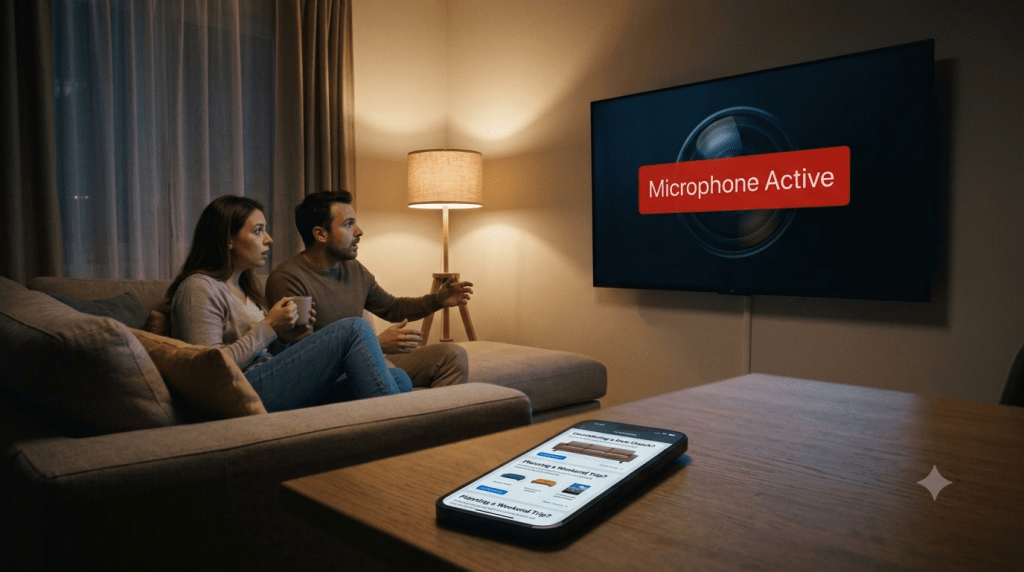
A voice assistant’s wake word, the specific phrase that triggers recording, gets detected by a small, low-power chip that processes audio locally on the device, without sending anything to the cloud until that word is heard. That part of the architecture is genuinely privacy-conscious by design. The gap is in execution: these systems frequently mishear ordinary conversation as the wake word. When that happens, the device activates, records a segment of whatever was actually said, and uploads it, often without any clear visual or audio cue that it just happened. Uploaded segments can end up reviewed by human auditors as part of a manufacturer’s quality process, meaning an accidental trigger isn’t just a wasted moment, it’s a real recording that left your house.
Where the Data Actually Goes
Recordings and viewing data don’t sit quietly with the TV manufacturer. They typically move into a broader chain: manufacturer, then advertising partners, then data brokers, companies that buy, aggregate, and resell consumer data across thousands of organizations most people have never heard of. Combined with other data sources, purchase history, location, browsing activity, this creates a profile far more detailed than what any single device collected on its own. This is the same underlying mechanism covered in how do apps know your age, gender, and interests, just with a TV’s microphone and screen as the collection point instead of a phone’s SDKs.
| Tracking Method | What It Captures | Can You Stop It |
|---|---|---|
| ACR | Everything on screen, including external devices like consoles and cable boxes | Disable transmission in settings; the chipset capability itself remains |
| Voice assistant wake word | Ambient audio, processed locally until the wake word triggers | Disable voice services or use a physical microphone switch |
| Mis-triggered recording | Conversations misheard as commands, then uploaded | No partial fix; only disabling voice features entirely stops it |
| Viewing data collection | What you watch, when, and for how long | Opt out through privacy settings |
The Forced Update Problem
Manufacturers have started adding surveillance-adjacent capabilities to TVs after purchase, through software updates the owner didn’t request and sometimes can’t remove. LG pushed Microsoft Copilot to existing LG TVs through a webOS update with no removal option, and over 36,000 users publicly objected. LG described it as a browser shortcut, but the concern raised by privacy advocates was more specific: an AI assistant with potential microphone access, added to a device already sitting in someone’s living room, without the option to take it back out. This is a meaningfully different problem than a setting you can toggle. It’s a capability added to hardware you already own, on the manufacturer’s schedule, not yours.
Standby Mode Isn’t Actually Off
Many smart TVs stay connected to the internet even when displayed as “off,” running in a low-power state rather than a genuinely disconnected one. Disabling ACR and voice features through the settings menu reduces what gets collected, but some diagnostic and connectivity data can keep flowing regardless. The only method that reliably guarantees zero data collection is physically unplugging the TV or disconnecting it from the network entirely, since anything short of that still relies on the manufacturer’s software actually honoring the toggle you set.
What You Can Actually Do About It
A few concrete steps meaningfully reduce exposure, even without full elimination:
- Disable ACR tracking in the TV’s privacy or settings menu, usually buried several layers deep
- Turn off voice recognition services if you don’t rely on voice commands
- Use a physical microphone switch if the TV has one, since it disconnects the hardware directly rather than relying on a software flag
- Cover the camera on TVs that include one
- Review which viewing and voice data has been logged to your account, and delete it where the manufacturer’s dashboard allows
Physical controls, a mic switch or a camera cover, are more reliable than software settings specifically because they remove the physical capability rather than asking the software to behave.
The Setup Screen Nobody Reads
Consent for most of this data collection gets buried in a privacy policy spanning dozens of pages, presented during initial setup when most people are trying to get the TV working rather than reading legal text. Opting out typically requires navigating several layers into a settings menu that isn’t shown during that initial setup at all. This mirrors the consent design covered in why do websites ask you to accept cookies in every country, where the friction of opting out is itself part of the design rather than an accident.
FAQs
How do smart TVs and voice assistants track you?
ACR reads your screen to identify everything you watch, regardless of source, while voice assistants listen locally for a wake word and occasionally record by mistake. Both feed data to manufacturers and, from there, often to advertisers and data brokers. See the sections above for how to limit each one.
Why is my TV suggesting ads for something I only talked about, never watched?
This is usually the combination of ACR-based viewing data and ambient voice detection working together, sometimes including a mis-triggered recording, to produce ad targeting that feels more precise than either signal alone would explain.
Does my TV listen when it’s turned off?
Many models remain in a low-power standby state with network connectivity and, in some cases, microphone functionality still active, even though the screen is off. Unplugging the TV is the only way to be certain nothing is still running.