What Is End-to-End Encryption
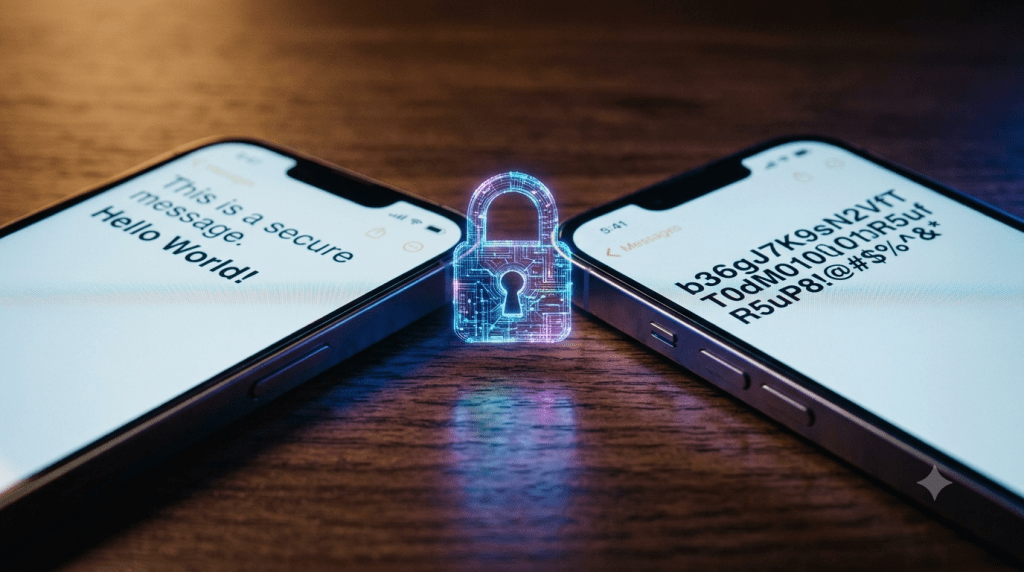
A public key, the half of an encryption pair that anyone can see and use to lock a message, is what makes end-to-end encryption, or E2EE, work: your device uses the recipient’s public key to scramble a message, and only their separate, secret private key can unscramble it. No server in between ever holds the private key, which is the whole point. If a company’s own servers could decrypt your messages, what they’re offering isn’t end-to-end encryption, whatever the marketing calls it.
How E2EE Actually Works
This relies on asymmetric encryption, a cryptographic method using two mathematically linked keys instead of one shared secret. Your public key gets shared openly, sometimes published directly in the app you’re using. Your private key stays on your device permanently and never gets transmitted anywhere. When someone sends you a message, their device encrypts it using your public key. Only your private key, sitting on your device alone, can reverse that process. A server relaying the message in between sees only ciphertext, encrypted data that’s meaningless without the matching private key.
E2EE vs TLS: The Distinction Nearly Everyone Blurs
TLS, the encryption protocol behind HTTPS, secures the connection between your device and a server. The server itself can still decrypt whatever you send it, since TLS protects the pipe, not the contents traveling through it. E2EE secures the payload directly, meaning the message itself stays encrypted all the way to the recipient’s device, and the service provider running the servers in between genuinely cannot read it, even if legally compelled to try. This is the single most confused concept in consumer security writing. A messaging app can use TLS to protect data in transit to its own servers while still being able to read every message once it arrives there. Only E2EE removes that capability entirely.
What E2EE Protects, and the Gap Almost Nobody Explains
| What It Protects | What It Doesn’t Protect |
|---|---|
| Message content: text, images, files | Metadata: who you’re talking to, when, and how often |
| Data while it’s traveling between devices | Data sitting at rest on a compromised device |
| Against eavesdroppers intercepting network traffic | Against malware or a keylogger already on your device |
| Against the service provider reading your content | Against unencrypted cloud backups of that same content |
Metadata Is Where Surveillance Actually Happens
E2EE locks the content of a conversation, but metadata, information like who you contacted, the timestamp, how frequently you communicate, and your IP address, typically remains fully visible to the service provider. This is how law enforcement and intelligence agencies build detailed social graphs of who’s talking to whom without ever needing to break a single encryption key. A provider can legally comply with a request for this metadata even while genuinely being unable to hand over message content, because the two are stored and protected completely differently. This is precisely why Meta can see who you’re messaging on WhatsApp and how often, despite the messages themselves being encrypted.
Your Device Is the Actual Weak Point
The encryption math behind E2EE is not the practical vulnerability most people should worry about. Your endpoint, the device where messages get decrypted and displayed, is. If your phone has malware, a keylogger, or someone gets physical access to it while unlocked, E2EE provides zero protection, since the message is being read in its decrypted form directly off the screen or the device’s storage, after the encryption has already done its job and stepped aside.
Cloud Backups Often Skip Encryption Entirely
This is a blind spot most consumer guides never mention. Many apps that apply genuine E2EE to messages in transit do not apply the same protection to cloud backups of those same messages. A WhatsApp chat history backed up to Google Drive or iCloud may sit there without the same encryption guarantee the live conversation had, meaning anyone who gains access to that cloud account, through a breach, a subpoena, or account compromise, can potentially read message history the original conversation was supposedly protected from.
Not All ‘E2EE’ Apps Offer the Same Protection
The label gets applied inconsistently across products, and the differences matter. Signal is widely regarded as the reference implementation, encrypting everything by default with no configuration required. WhatsApp uses the same underlying Signal protocol for message content but still collects substantial metadata separately. Telegram only applies E2EE to opt-in Secret Chats, meaning regular Telegram conversations are not end-to-end encrypted by default, a detail that surprises many users who assume the whole app works this way. iMessage offers strong E2EE for messages between Apple devices but has historically had cloud backup configurations that undermined that protection unless separately secured. Seeing “encrypted” on a product page doesn’t tell you which of these categories you’re actually getting.
The Law Enforcement Backdoor Debate
Governments in several countries have periodically pushed for mandated backdoors, a deliberate weakness built into encryption that would let authorities decrypt communications when legally required. Security researchers broadly argue that any such backdoor, once it exists, becomes a vulnerability available to anyone who finds it, not just the intended authorities, meaning weakening E2EE for law enforcement access weakens it for every user of that system simultaneously. This tension between investigative access and universal security remains an active, unresolved policy debate rather than a settled technical question.
Quantum Computing on the Horizon
Current E2EE relies on mathematical problems that are extremely difficult for ordinary computers to solve but that a sufficiently powerful quantum computer could, in theory, solve efficiently using an approach known as Shor’s algorithm. Estimates for when quantum computers might reach that capability generally fall somewhere in the coming ten to twenty years, not tomorrow, but seriously enough that researchers are already developing post-quantum cryptography, encryption methods specifically designed to resist quantum-based attacks, so that today’s messaging protocols have a migration path before that threshold arrives.
FAQs
What is end-to-end encryption, in short?
It means only the sender and recipient can read a message’s content, not the app, not the server, not your ISP. See the sections above for exactly what it does and doesn’t cover, since the gaps matter as much as the protection.
If WhatsApp is E2EE, why can Meta see who I message?
Because E2EE protects message content specifically, not metadata. Meta can see who you’re contacting and how often even though it genuinely cannot read what you wrote.
Does E2EE protect me if my phone is hacked?
No. E2EE protects data in transit between devices. Once a message is decrypted and displayed on a compromised device, malware or a keylogger on that device can read it exactly as you can.